

Active Cosmetic Ingredients Explained: A Developer's Data Guide
Active Cosmetic Ingredients Explained: A Developer's Data Guide
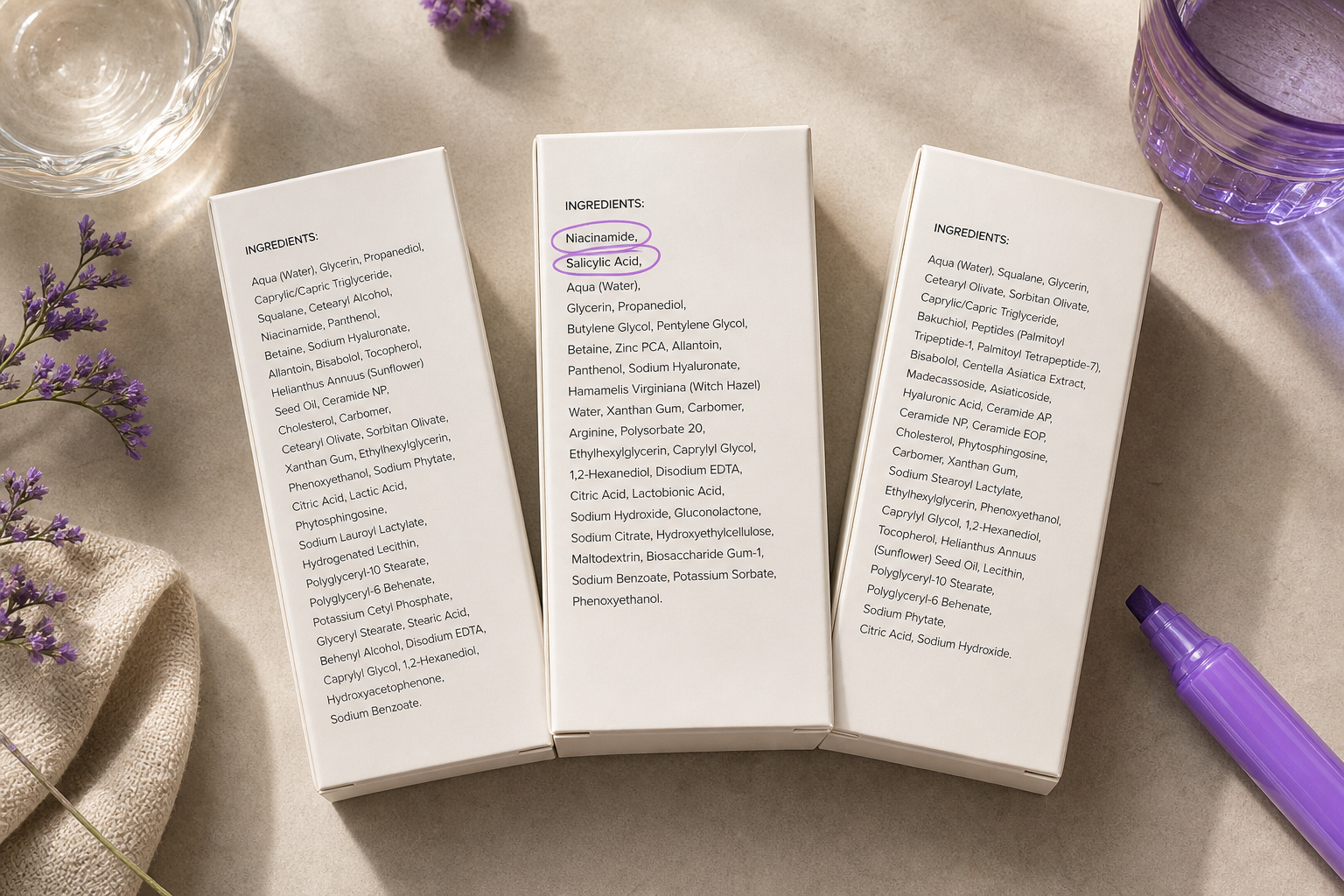
Your skincare app ingests a product feed. Each SKU arrives with an INCI declaration of 20 to 50 ingredients — a wall of Latin and chemical names that no end user will read. Your recommendation engine, your filter UI, and your "why this product?" copy all hinge on the same upstream question: which of those names actually matter? That question is what makes active cosmetic ingredients a data classification problem rather than a marketing label. The wrong abstraction at this layer cascades into bad search facets, misleading badges, and — in regulated markets — claim-substantiation exposure for the brands you syndicate.
Table of Contents
- Why "Active Cosmetic Ingredients" Is a Data Problem, Not a Marketing Term
- What Qualifies as an Active — INCI Position, Concentration Thresholds, and Regulatory Signals
- The Five-Step Pipeline for Extracting Actives from an INCI Declaration
- Reading the Score Fields — Severity, Comedogenicity, Irritancy, and Safety Status
- Marketed Actives vs. Regulated Actives — Common Misclassifications That Create Liability
- Build vs. Buy — A Technical Checklist for Integrating Active Ingredient Data
- Active Ingredient Data — Developer FAQ
Why "Active Cosmetic Ingredients" Is a Data Problem, Not a Marketing Term
You are not designing a beauty magazine. You are designing a system that ingests structured chemical data and projects it onto consumer-facing surfaces. The challenge with active cosmetic ingredients is that the term sits at the seam between two domains with incompatible definitions — and your data model has to reconcile them before any UI gets built.
Start with the formula-weight reality. According to packaging educator The Skin Science Company, the first 5 to 6 ingredients on an INCI list typically account for 80–95% of the product by weight, while everything from position 7 onward is usually present at 1% or less. The implication for your parser is sharp: raw list position is a weak proxy for "important." The ingredient a brand markets most heavily — the headline retinol, the "powered by" botanical — frequently lives deep inside the sub-1% block, where order is no longer concentration-ordered at all.
The first five ingredients carry the formula. The five that carry the marketing usually live below the 1% line.
Cosmetic science offers a cleaner split for data modeling. Both the Cosmethically Active Complete Guide and the PMC review on cosmetic complexities frame every formulation as the sum of three categories: cosmetically active ingredients, vehicle/base ingredients, and auxiliary components (preservatives, fragrances, colorants, chelators, pH adjusters). Mapped to a database schema, that taxonomy resolves to a single enum field on each ingredient row:
role: "active" | "vehicle" | "preservative" | "antioxidant" |
      "ph_adjuster" | "chelator" | "fragrance" | "colorant"
That field is the foundation of every downstream feature — filters, badges, recommendations, allergen flags. Without it, your platform can only render strings.
Now the harder layer: the term "active" is contested. Vendor literature — including DermapenWorld's actives cheat sheet — labels almost any benefit-claiming compound an active, sweeping in hydrators, antioxidants, and humectants. Clinical dermatology is stricter. Dr. Walter J. Liszewski of Northwestern Medicine defines an active as a component proven to target a specific skin concern — proven being the operative word. Under that definition, the canonical actives are a much smaller set: retinoids, salicylic acid, benzoyl peroxide, hydroquinone, and a handful of others with documented dose–response evidence.
The consequence for your platform is asymmetric. If you inherit the vendor-loose definition, your app over-promises and exposes your brand partners (and yourself) to claim-substantiation challenges. If you inherit the clinical-strict definition, you under-represent legitimately formulated products and lose to competitors who lean into the looser frame. Neither extreme is defensible. The fix is not to pick a side — it is to classify every ingredient against multiple independent signals (regulatory status, evidentiary base, position band, concentration threshold) and let your UI surface the distinction transparently. The rest of this guide is about how to build that classification layer.
What Qualifies as an Active — INCI Position, Concentration Thresholds, and Regulatory Signals
Three signals, evaluated together, will get you to a defensible active classification for any given ingredient on any given product.
Signal 1 — INCI list position. Ingredients appear in descending weight order, but Formula Botanica and The Skin Science Company both note that ingredients at or below 1% may be listed in any order at the end, with colorants last. Position 1–6 is a strong concentration signal. Position 7+ is a weak one.
Signal 2 — Concentration threshold for efficacy. Salicylic acid is regulated as an OTC active in US acne products at 0.5–2%. Glycolic acid generally requires ≥5% for meaningful exfoliation. Niacinamide shows barrier effects in the 2–5% band. An ingredient sitting in the sub-1% block, with a published efficacy threshold of 5%, is almost certainly underdosed.
Signal 3 — Regulatory classification per jurisdiction. The same molecule can be an OTC drug active in the United States and a restricted cosmetic ingredient in the European Union. Same INCI name, two database statuses.
| Ingredient | Typical role | US classification | EU classification | Effective band |
|---|---|---|---|---|
| Salicylic acid | Exfoliant, acne | OTC active drug | Cosmetic (restricted) | 0.5–2% |
| Retinol | Anti-aging | Cosmetic | Cosmetic (capped) | 0.1–1% |
| Niacinamide | Barrier, brightening | Cosmetic | Cosmetic | 2–5% |
| Hyaluronic acid | Humectant | Cosmetic | Cosmetic | 0.1–2% |
| Glycerin | Humectant / vehicle | Cosmetic (vehicle) | Cosmetic (vehicle) | 3–20% |
| Cetyl alcohol | Emollient | Cosmetic (vehicle) | Cosmetic (vehicle) | 1–5% |
| Phenoxyethanol | Preservative | Cosmetic (preservative) | Cosmetic (≤1%) | 0.3–1% |
Walk through salicylic acid in detail. The US FDA OTC monograph treats it as an active drug ingredient in acne products, which triggers mandatory Drug Facts labeling and specific claim language. The EU treats the same molecule under cosmetic regulation with concentration restrictions and different labeling conventions. Same INCI name. Two database statuses. Two different UI treatments required for the same SKU shipped to two markets.
The practical implication is that a static is_active: true/false boolean is insufficient at the data layer. The minimum viable record needs: (a) jurisdiction, (b) role classification, (c) effective concentration band, and (d) regulatory status code per jurisdiction. Anything less and you lose the ability to render correct copy in your second market.
One QA heuristic worth building into your ingestion pipeline: water-containing products must include a preservative system. The Skin Science Company is explicit on this — if you parse an aqueous formula and detect no preservative, either the product is anhydrous (unlikely if "Aqua" is listed) or the preservative is hiding under a non-obvious name. Flag those rows for manual review rather than passing them downstream as clean.
The Five-Step Pipeline for Extracting Actives from an INCI Declaration
Treat ingredient classification as a pipeline, not a single lookup. Each step has its own failure modes and its own data contracts.
Step 1 — Acquire the raw INCI string. Sources include supplier SDS and COA documents, product label OCR, or vendor API feeds. Formula Botanica notes that INCI declaration is not universally mandated across every market, so your ingestion layer should track declaration_source and declaration_confidence alongside the string itself. A label-scraped INCI from a non-mandating market is not the same primary source as an SDS from a regulated EU supplier.
Step 2 — Normalize and tokenize. Split on commas and semicolons. Trim whitespace. Lowercase. Strip diacritics. Then map alternate spellings and trade names to canonical INCI: "Vit C" → "Ascorbic Acid"; "HA" → "Sodium Hyaluronate"; "Vitamin E" → "Tocopherol". Resolution should happen via a canonical chemical identifier — CAS numbers are the standard. The Dermalytics endpoint GET /v1/ingredients/{name} returns canonical name, synonyms, and CAS/EC identifiers in a single response for exactly this normalization step.
Step 3 — Infer position band and concentration. Position 1–5 = primary band (likely 5–80% each). Position 6 through the implicit "≤1%" break = mid band. Everything after = sub-1% block where order is arbitrary, per the Skin Science Company guide. Attach a position_band enum (primary | mid | trace) to each parsed ingredient. Resist the temptation to emit a pseudo-precise percentage — you do not have that data, and pretending you do is how false claims propagate.
Step 4 — Classify role per ingredient. Look up each canonical ingredient against a reference dataset and tag it with one of the role enums introduced earlier. The functional-class taxonomy in the PMC review — preservatives, antioxidants, pH adjusters, chelators, fragrances, dedicated actives — is a clean schema baseline. Resist collapsing edge cases (a humectant that also functions as a vehicle, like glycerin) into a single role; allow a primary_role field plus a secondary_roles array.
Step 5 — Apply jurisdictional and efficacy overlays. For each ingredient tagged role: "active", resolve regulatory status for the user's market (US, EU, CA) and compare the inferred position band against the published efficacy threshold. An active at position 25 in the sub-1% block, with an efficacy threshold of 5%, gets a likely_underdosed: true flag. That flag is what allows your UI to show a brand's marketed active without endorsing its likely clinical effect.

The output of a clean pipeline run looks like this:
{
  "input_inci": "Aqua, Glycerin, Niacinamide, Cetyl Alcohol, ...",
  "parsed": [
    {
      "canonical_name": "Niacinamide",
      "cas": "98-92-0",
      "position": 3,
      "position_band": "primary",
      "role": "active",
      "regulatory_status_us": "cosmetic",
      "regulatory_status_eu": "cosmetic",
      "efficacy_threshold_pct": [2, 5],
      "likely_underdosed": false,
      "comedogenicity_score": 0,
      "irritancy_score": 1,
      "safety_status": "approved"
    }
  ]
}
Every field above is a discrete decision your platform now does not have to make at query time. The work happens once, at ingestion. The UI just reads.
Reading the Score Fields — Severity, Comedogenicity, Irritancy, and Safety Status
Classifying an ingredient as active is step one. The clinical and safety metadata attached to that active is what actually drives usable UI. Five fields do most of the work in a structured ingredient response, and each one has its own rendering rules.
- Severity label. A categorical tag — typically
low | moderate | high— attached to an ingredient's risk profile for sensitive populations. It is not a clinical diagnosis. It is a routing signal that determines whether your UI shows a passive badge, a warning modal, or nothing at all. Population-specific contraindications (pregnancy, broken skin, paediatric use) should live in separate fields, not collapse into severity. A retinoid ismoderateseverity generally andcontraindicatedspecifically during pregnancy — those are two different facts, and your data model should keep them separate. - Comedogenicity score (0–5). A graded estimate of pore-clogging potential, where 0 is non-comedogenic and 5 is highly comedogenic. This field is what makes acne-prone-user UX possible. Your recommender should filter or down-rank ingredients with scores ≥3 for users who self-identify as acne-prone. The caveat: comedogenicity is concentration- and formulation-dependent. The score is a starting heuristic for ranking and filtering, not a verdict on any specific finished product. Render it as a numeric badge with a tooltip explaining the scale; do not translate "3" into "bad" without context.
- Irritancy score (0–5). Parallel scale to comedogenicity, capturing skin-irritation potential. Pair it with severity for usable copy: an irritancy 4 ingredient at high concentration in the primary band warrants different UI than an irritancy 2 ingredient buried in the sub-1% block. The score alone is insufficient — combine it with
position_bandfrom your pipeline to drive accurate user-facing language. - CAS and EC identifiers. CAS (Chemical Abstracts Service) and EC (European Community) numbers are the canonical chemical identifiers — non-negotiable for deduplication, cross-database joins, and regulatory lookup. Two products may list "Tocopherol" and "Vitamin E"; the shared CAS number (10191-41-0) resolves them to a single underlying entity. Formula Botanica makes the point cleanly that canonical naming discipline — supported by SDS, COA, and reference databases — is foundational to safe, compliant product development. The same logic applies to your data infrastructure: without CAS as a join key, your ingredient table will fragment.
- Safety status. A jurisdiction-aware enum:
approved | approved_with_restrictions | restricted | banned. The same ingredient can carry different statuses across FDA, EU CosIng, and Health Canada — store this value per jurisdiction, not as a single global flag. The PMC review reminds us that product safety is a system-level property: a restricted ingredient at a compliant concentration in a properly preserved vehicle is not equivalent to the same molecule misused at a higher dose. Your data layer captures the molecule-level status; the in-product safety judgment requires both molecule and formulation context.
A raw INCI name is data. Paired with CAS, severity, concentration band, and jurisdiction status, it becomes an interface.
Tie this back to API contract design. The difference between a one-field response (is_safe: true) and a structured response (severity + comedogenicity + irritancy + CAS + safety_status_per_jurisdiction) is the difference between a toy and a product feature. Liszewski's clinical guidance from Northwestern Medicine is that users should be able to ignore most marketing copy and focus on identifying relevant active ingredients. Your data fields are what make that focusing technically possible — every score, identifier, and status enum is a lever the UI can pull to show one thing and hide another.

Marketed Actives vs. Regulated Actives — Common Misclassifications That Create Liability
The vendor-versus-clinical definitional split from Section 1 plays out in production as two distinct failure modes — and they cost differently.
False positive. An ingredient is marketed as an active but lacks either regulatory active classification or dose–response evidence at in-use concentration. The classic example: a botanical extract listed at the bottom of the INCI in the sub-1% block, headlined on the front of the package as "Packed with [extract]." The Skin Science Company is direct that marketing prominence at this concentration is not a reliable proxy for mechanistic impact. The ingredient is there. It is not driving the product's effect.
False negative. A genuine active is hidden inside a proprietary blend name, a synergistic complex, or an unrecognised synonym. "Vitamin Complex" or "Anti-Aging Matrix" defeats keyword matching. This is what your normalization layer from Step 2 of the pipeline is meant to catch — and where the maintenance burden lives if you build in-house.
| Ingredient on label | How it's marketed | US regulatory reality | Typical position | Risk if displayed as hero active |
|---|---|---|---|---|
| Hyaluronic acid | "Deep hydration active" | Cosmetic humectant | Often sub-1% | Overstates effect; brand claim exposure |
| Niacinamide | "Brightening active" | Cosmetic | Usually 2–5%, primary band | Defensible if position supports band |
| Salicylic acid | "Acne active" | OTC drug (0.5–2%) | Drug Facts panel | Must respect OTC labeling rules |
| "Vitamin Complex" | "Antioxidant active blend" | Composite, unquantified | Variable | Cannot resolve to CAS; flag manually |
| Botanical extract <0.5% | "Powered by [plant]" | Cosmetic, low evidence | Sub-1%, deep | Prominence ≠ functional contribution |
| Peptide blend (proprietary) | "Anti-aging active" | Cosmetic | Usually sub-1% | Limited public dose-response data |
The misclassification cost is asymmetric. False positives expose downstream brands to claim-substantiation challenges — and expose your platform if you surfaced those claims algorithmically. False negatives leave functional actives invisible to users, hurting trust in your product catalog and your recommendation quality.
The PMC review reframes the underlying issue: product performance emerges from the interaction of preservatives, pH adjusters, vehicles, chelators, fragrances, and dedicated actives. A "one active = one effect" UI is technically defensible only when the named active sits at efficacy concentration and the vehicle supports its delivery. Otherwise you are publishing a marketing claim, not a technical fact.
A UI pattern that resolves this without lying: display marketed actives as claimed by brand, and display regulator-classified actives at evidentiary concentration as regulated active. Two distinct visual treatments. Two distinct data fields. Do not collapse them into a single badge.
The developer takeaway is to build the misclassification audit into your ingestion pipeline rather than relying on post-hoc moderation. Every ingredient should land in your database with marketing_claim_source and regulatory_evidence_source tracked separately. The product team that wants to filter on "FDA OTC actives only" gets a clean query. The marketing team that wants to surface brand-claimed actives with appropriate disclaimers gets a different one. Both queries hit the same table, but they read different columns.
Build vs. Buy — A Technical Checklist for Integrating Active Ingredient Data
Every team that adds ingredient data to a product hits the same fork: build the reference set in-house or consume a normalized API. The relevant variables are catalog size, jurisdictional reach, refresh cadence, and how much classification risk you are willing to own.
- Define your minimum viable ingredient record. At baseline you need: canonical INCI name, CAS number, role enum (active/vehicle/preservative/etc.), severity label, comedogenicity 0–5, irritancy 0–5, safety_status per jurisdiction, and efficacy concentration band. Anything less and your UI cannot do more than display strings. Lock this contract before you write any ingestion code.
- Decide your jurisdictional scope upfront. US-only, EU-only, US+EU+CA, or global. This determines whether you need one regulatory overlay or three. As the salicylic acid example showed, the same molecule shifts status across markets — your data layer must store regulatory status per jurisdiction, not as a single global field. Retrofitting jurisdictional storage onto an already-populated table is expensive.
- Source the canonical reference set. Either compile your own from FDA OTC monographs, EU CosIng, and Health Canada listings (expect well over 25,000 ingredients across regimes once synonyms are accounted for), or consume a normalized API. Formula Botanica underscores that correct INCI naming and well-documented supplier paperwork — SDS, COA, CosIng cross-checks — are foundational to compliant product development; the same standard applies to your data feed. The Dermalytics API indexes over 25,000 ingredients drawn from FDA, EU CosIng, and Health Canada, accessible via
GET /v1/ingredients/{name}andPOST /v1/analyzefor batch INCI submission. - Build the synonym and alternate-name map. "Vitamin E" → "Tocopherol" → CAS 10191-41-0. "Vit C" → "Ascorbic Acid". "HA" → "Sodium Hyaluronate". Without this layer, you will under-detect actives at exactly the points where users care most. Maintenance is the hidden cost — every new launch may introduce trade names your map doesn't yet know.
- Plan refresh cadence. Regulatory data is not static. FDA monographs revise on regulatory timelines. The EU updates Annexes multiple times per year. Health Canada changes more slowly but still changes. Quarterly is the minimum defensible cadence; event-driven refresh via a vendor feed is better. If you build in-house, allocate recurring engineering time to monitor regulatory bulletins — this work never goes away.
Regulatory data is a moving target. Treat your ingredient reference set as infrastructure, not a one-time seed file.
- Design the active display contract. Decide what your UI surfaces and how. Three common patterns: (a) a single "active" badge on each ingredient row in a list; (b) an expandable card showing severity, score, and concentration band; (c) a separate "Actives" tab on the product detail page. The Sunshine State Dermatology guidance — that users should focus on actives near the top of the INCI list — maps directly to UI prioritisation logic. Use
position_bandto order the actives surface, not raw INCI position. - Validate against real formulations before launch. Run 15 to 25 real product INCI lists through your pipeline end-to-end. Verify: did every preservative get tagged? Did the parser catch proprietary blends or hand them off to manual review? Did jurisdictional status resolve correctly per market? Did the sub-1% block produce sensible position bands? This is integration testing for ingredient data — skipping it is how false positives reach production. Build a small golden-dataset suite and re-run it after every reference-set refresh.
- Decide build vs. buy with a single test. If your catalog is under roughly 500 SKUs in one jurisdiction with a low launch cadence, an in-house static list is defensible — you can keep it accurate with manageable engineering effort. The moment you cross any of: multi-market scope, monthly catalog updates, more than ~500 SKUs, or external compliance scrutiny — the maintenance cost of an in-house reference set typically exceeds the cost of a purpose-built API. Credit-based pricing models that charge only on successful match align cost with realized value, which is the relevant economic shape when you are growing a catalog and not all queries will resolve.
Active Ingredient Data — Developer FAQ
1. How do I distinguish a regulated active from a marketed "active"?
Check three signals in order. First, jurisdictional regulatory status — is the ingredient on an FDA OTC monograph or an EU/CA active register? Second, INCI list position — is it placed where its known efficacy concentration would put it (niacinamide at position 3–6 is plausibly at 2–5%)? Third, dose–response evidence at the inferred concentration. Dr. Walter J. Liszewski of Northwestern Medicine frames it cleanly: an active is a component proven to target a specific concern, with proof being the operative word. If you cannot find proof at in-use concentration, do not render the ingredient as a regulated active in your UI.
2. Why do active ingredient lists differ across markets for the same product?
Because jurisdictional classification differs. Salicylic acid is an OTC drug active in the US (triggering mandatory Drug Facts labeling) and a cosmetic with concentration restrictions in the EU. Brands also choose which actives to feature based on local claim rules and consumer expectations. Formula Botanica notes that INCI declaration itself is not universally mandated, which adds variance even on the same SKU shipped to different markets. Your data layer should treat the regional INCI as the source of truth for each region's listing, not assume a single canonical declaration.
3. Can I display only the actives and hide the rest of the INCI list?
Legally, your app is not the product label — you have UI discretion. Practically, the full INCI list builds user trust and is essential for allergen-sensitive users who need to verify the absence of specific compounds. The best pattern surfaces actives prominently (a badge or top-of-card summary) while keeping the full INCI one tap away. The Skin Science Company's point about the position-vs-marketing gap applies in reverse here: the sub-1% block matters for transparency even when it doesn't matter for efficacy. Hiding it costs you credibility with the users most likely to read carefully.
4. How often does active ingredient classification actually change?
Often enough that quarterly refresh is the floor, not the ceiling. FDA OTC monographs revise on regulatory timelines. EU CosIng updates with each Annex amendment, multiple times per year. Health Canada changes more slowly but still on a publishable cadence. If your data is six months stale, you risk surfacing an ingredient under an obsolete status — the kind of error that becomes visible only after a customer complaint or a press inquiry. Either subscribe to a data feed that publishes updates as they occur, or budget recurring engineering time for reconciliation against FDA, EU CosIng, and Health Canada sources.
5. What's the lowest-friction starting point?
For an MVP with under 50 products in one jurisdiction, a hand-curated static list of 30 to 50 ingredients keyed by canonical INCI is defensible — you can ship in roughly a week. The day you add a second jurisdiction, cross ~500 SKUs, or get a compliance question you cannot answer in an afternoon, migrate to a structured API. The POST /v1/analyze endpoint is built for batch INCI submission and returns the full classified payload — role, scores, jurisdictional status, CAS, safety_status — in a single call. Pair that with a credit-based billing model that charges only on successful matches and the economics track your actual catalog growth rather than your peak hypothetical traffic. The migration path from static list to API is straightforward as long as your initial schema (Step 1 of the build-vs-buy checklist) anticipated it.